
Each season of the Design/Build/Fly competition introduces new rules and constraints that influence the structural design of the aircraft. Among other requirements, last year’s competition missions required the aircraft to carry external fuel tanks as well as one internal fuel tank. Ensuring high payload capacity while maintaining the lowest possible structural mass therefore represented one of the key engineering challenges of the 2024/2025 season.
Since the development of our unmanned aircraft is based on numerical simulations and experimental testing, we decided to verify the results of our numerical calculations with an experiment at this stage of development. We conducted a comprehensive wing load test and obtained valuable data for further improvements of the aircraft for the Design/Build/Fly 2025 competition (DBF 2025).
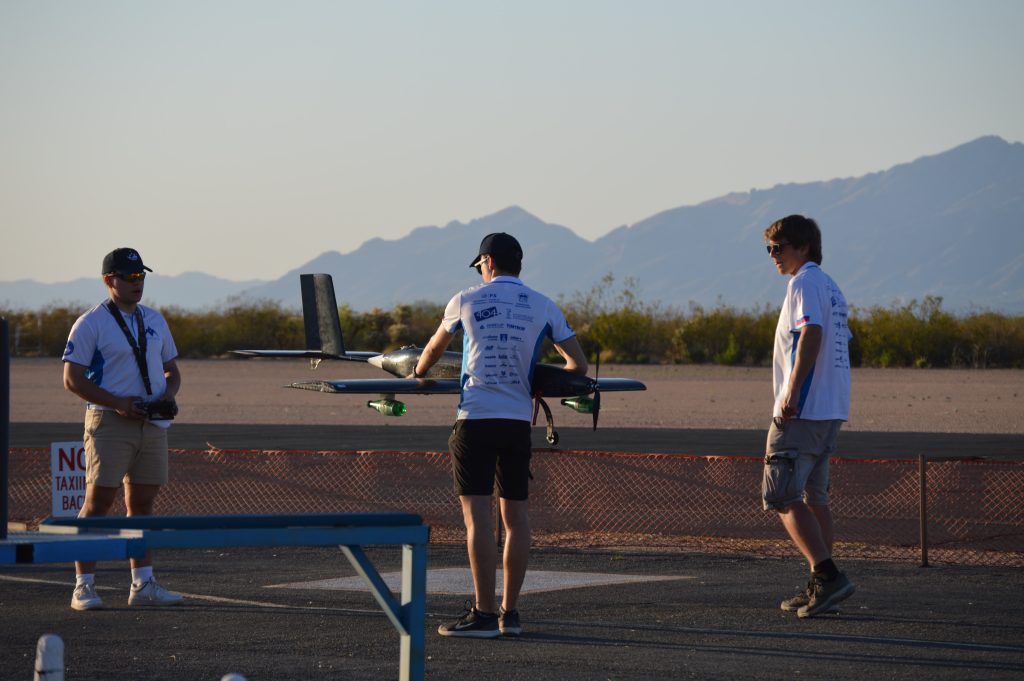
Challenges of the Design/Build/Fly 2025 competition
The Design/Build/Fly competition, organized by the American Institute of Aeronautics and Astronautics (AIAA), brings new rules, different constrictions and interesting flight missions every year. The challenges are divided into four missions—one static mission and three flight missions. Each mission is scored differently and must be completed in a specific order. The first mission requires a flight demonstration and contributes one point, while the results of the second, third, and static missions are normalized against the best results achieved during the competition.
The tasks last year required rapid flight, transport of payload as well as carrying and deploying a small autonomous glider, X-1. The payload carried in so-called “fuel tanks” greatly affected flight mission scores, thus making it the focus of this year’s project.
The final score of the competition is calculated as the sum of all flight mission performances and a technical report that the team must submit ahead of time. The report entails simulations, conceptual and detailed design of the aircraft as well as its testing and technical drawings.
Since last year’s competition objectives called for great load-bearing abilities of our competition aircraft, it was essential to thoroughly stress test the aircraft’s wings for the expected aircraft maximum takeoff weight of 12 kg and a force of 10 g in turns.
Setting up the experiment
The aircraft’s wing carries the most stress in its middle, where the bending moment is the strongest. Therefore, the team wanted to determine at what load the wing fails and performed a three-point bending test to evaluate its structural integrity. A test wing was built and mounted on a test stand with its ends securely fixed to prevent any movement, while an electrically actuated load applicator was positioned in the center of the wing to apply force.
The testing rig had a top and bottom support. The support on top had the shape of the internal fuel tank bed, which carried the majority of the aircraft’s load. Simply put, the entire force acting on the aircraft was simulated with the top support.
The base of the bottom support was a square steel tube with beds from steel pipes that served as pinned supports for the test wing. The distance between the two contact points was calculated to match the bending moment of the top support’s force on the middle of the wing with the force that is acting on the wing in a turn.
The test was performed with the Zwick/Roell Z100 materials testing machine, which is capable of applying loads up to 100 kN. The load applicator has 320 mm of travel with speeds up to 600 mm/min and a positional accuracy of 20 µm.
For the test, the bottom support was bolted at the base of the machine and the top support was clamped in its grip, as seen in the picture below.

Wing structure
The test wing was not completely identical to the final aircraft’s wing – the span of the test wing was shorter, slightly extending over its inner supports, since the material towards the end of the wing is not under significant stress and is thus not as relevant for the experiment. This decision spared us some material and manufacturing time. Because of the testing rig’s constraints, a part of the wing’s trailing edge was also not included. The specially built test wing had a similar internal structure to the final wing, missing only the control surface structure and having a slightly different rib distribution. The computer model of the test wing is shown in the picture below.

The test wing was a wet layup laminate using carbon and glass fibre with epoxy matrix and Airex foam. The laminate was then placed into the mould and vacuum-bagged, leaving epoxy to polymerise for a few hours and later curing the laminate at a higher temperature. The inner structure, made from the same laminates, was laser cut and secured in the wing with epoxy adhesive mixed with the lightweight thixotropic agent Aerosil.
Testing
For the three-point bending test, the bottom support was bolted to the machine and the wing was placed in the middle. The top support, with which we applied force to the wing, was secured in the grips of the load applicator.
Testing followed, where we measured travel and force of the load applicator. The wing was loaded with the speed of 20 mm/min and required to hold the force of at least 3000 N. Because of various dynamic effects, uncertainties with the manufacturing process and material properties, we incorporated a safety factor of 2.5.
Below you can watch a video showing the testing of the wing’s maximum load capacity.
Results
The graph below shows a linear increase of the force with deflections up to about 15.55 mm, where the force was approximately 6400 N. At that point, we encountered a small but sudden drop in the force that was followed by a lowered incline. A similar occurrence happened at a deflection of 17.75 mm. There was no visible damage on the outside of the wing during testing, however, the fracturing of the material could be heard.
The wing failed at a deflection of 21.15 mm with the applied force of 7742 N. After failure, which was accompanied with a loud fracturing sound, the force fell steeply and with that the test was concluded.
The test wing was then cut open to examine the damage. Some of the ribs at the trailing edge near the middle of the wing had shear failure. Thus assuming that the loud cracks heard during testing were because of rib failure. Those would affect the rigidity of the wing, which can be seen on the graph as a lowered incline of the curve.
The final failure of the wing happened due to delamination of the upper skin near the root of the wing, which was also accompanied with a loud crack. In this case, the Airex foam broke because of great shear stress. At that point, the load capacity of the wing dropped, as seen on the graph.
The wing held more than double its required load before it failed. However, as it turned out it was very oversized and the laminate in the main spar could be made thinner to lower the weight of the wing.
Numerical simulation
The test was also numerically simulated in Ansys software, using the Advanced Composite PrepPost (ACP) module with the finite element method. The analysis was based on the classical lamination theory (CLT). Since the wing is symmetrical, we analysed only half of the wing. In its middle we used a symmetrical boundary condition, with a fixed support added on the surface where the top support would apply force. The load was then applied where the bottom support would make contact with the wing, however, the force was halved as only half of the wing was analysed. Deflections were measured at different loads and the results were compared in the graph below.

The test and the calculation did not give the same results for the wing’s failure threshold, because the CLT deems laminate layers as inseparable, making the analysis unable to predict delamination. Nevertheless, the simulation showed that the material around the top support was nearing failure because of compressive stress, which can be seen as the green area in the picture below. The red area at the front edge of the wing shows skin failure, which is the area where stress builds up because of the top support’s corner.

Discussion
The numerical simulation showed critical areas where wing failure could occur. Since the method used had its constrictions, we could not predict delamination, however, skin failure that was predicted at the front edge of the wing was the result of the boundary conditions set – the modelled support was rigid and had sharp edges, whereas the support used in the test was elastic and had rounded edges. The discrepancies in deflections between the numerical analysis and the test were great, the cause being an overestimation of the model’s material properties that were sourced from the Ansys’ library of materials, rigid joints between the modelled components, a simplified model for the support used in the analysis as well as disregarding the support’s deflection during testing.
Improvements
For more accurate results, we would have to test the materials used, since the models turned out to be more rigid than the actual materials. In addition, the deflection measurements of the test wing also included support deflections. Hence, those should also be measured and then subtracted. With these two changes that will be implemented this season, the results and discrepancies between the numerical simulation and testing will be significantly improved.
Conclusion
The test proved that the wing is capable of carrying the required loads. Even more, the wing turned out to be oversized, allowing the team to further lower its weight. The experiment also showed the significance of testing and measuring, since the numerical analyses are not always able to simulate all of the processes and features, including precise material properties.
The Edvard Rusjan Team is truly grateful for Dewesoft’s support of the Design, Build, Fly project. With their help, we were able to perform more detailed tests and refine our data, thus improving our overall quality of production that can rise to every challenge.